Brand Strategy
Brand Identity · Chapter Strategy · Membership Economics
The Music Union 512 · Chapter 512 · Austin, Texas · musicunion.co · Confidential — March 2026
"The Music Union" sounds like it has existed for 50 years and will exist for 50 more. That permanence is intentional — and it is the foundation every chapter is built on.
The Brand: The Music Union
The Music Union is a national creative campus brand built for the music and content industries. Each location operates as a named Chapter, identified by the local area code of the city it serves. The founding chapter — The Music Union 512 — opens in East Austin, Texas at 4405 Springdale Road.
The brand rests on a single organizing insight: musicians, creators, and the industry professionals who surround them all need the same things — great spaces, great community, and a physical home for their work. The Music Union provides all three, in one destination, in every major music market in America.
The Name
- Institutional Weight. "Union" implies collective ownership, mutual benefit, and shared belonging — the exact community dynamic that makes a music campus thrive rather than just operate.
- Membership Language. Union members have cards, benefits, and standing. This language directly supports the Union Card membership system built into every chapter from day one.
- Expansion Architecture. A union is explicitly cross-city by nature. The name signals from the beginning that this is an organization, not a venue.
- "Spoken Identity. "The Union" and "The Union Stage" as shorthand are among the strongest two-word identifiers in music. Short, weighted, impossible to mistake for anything else.
- Chapter Logic. Unions have chapters. Chapters have numbers. The entire expansion framework is already embedded in the name.
The Chapter Number
Each Music Union location is identified by the local area code. This is not an arbitrary numbering system — in most American cities, the local area code is already one of the most beloved civic identifiers in existence. It is worn on hats, tattooed on people, and built into local culture long before we arrive.
Austin's 512 is among the most iconic area codes in the country. By naming the founding chapter The Music Union 512, we inherit decades of existing local pride without spending a dollar to create it.
When the second chapter opens in Nashville, it becomes The Music Union 615. Los Angeles is 213. New York is 212. Each chapter has its own identity, its own community, its own character — and all of them belong to the same Union.
The Chapter System
How Chapters Work
A chapter is a fully operational Music Union campus in a specific city, running the full suite of services — themed rehearsal rooms, production suites, podcast and creator studios, music industry coworking, a live venue and bar, and the Every Surface Is a Set content campus design. Every chapter operates under the same brand standards, the same Union Card membership network, and the same design philosophy.
What differs between chapters is what should differ: the specific themes, the local artists commissioned for murals, the resident businesses, the character of the community. The Music Union 512 is unmistakably Austin. The Music Union 615 will be unmistakably Nashville. The brand is the constant. The city is the variable.
512 · Austin
The National Chapter Map
| City | Chapter | Market Identity |
|---|---|---|
| Austin | The Music Union 512 | Founding Chapter — Live Music Capital of the World |
| Nashville | The Music Union 615 | Country, Americana, singer-songwriter capital |
| Los Angeles | The Music Union 213 | Largest music market in America |
| New York | The Music Union 212 | East Coast flagship |
| Chicago | The Music Union 312 | Midwest anchor |
| Atlanta | The Music Union 404 | Hip-hop, R&B, gospel hub |
| New Orleans | The Music Union 504 | Jazz, blues, cultural heritage |
| Seattle | The Music Union 206 | Pacific Northwest indie market |
| Dallas | The Music Union 214 | Texas Chapter 2 |
| Miami | The Music Union 305 | Latin, electronic, Caribbean |
How It Sounds in Conversation
| Said | What It Communicates |
|---|---|
| "Meet me at The Union" | Works in any city. Always correct. Never needs qualification. |
| "I'm at 512" | Austin local shorthand. Instantly signals insider status. |
| "I'm a 512 member" | Home chapter on the Union Card — worn like a badge. |
| "I recorded at 615 last week" | Chapter-hopping on tour. A national network in four words. |
| "We need a Union in Denver" | Organic expansion demand generated by the community itself. |
The Investor Story
The chapter system fundamentally changes what is being pitched. This is not a single music venue or a local real estate play. It is the first chapter of a national music infrastructure brand — and the entire second act of the company is already named, already branded, and already conceptually sold before Chapter 512 opens its doors.
| Single-Location Venue | The Music Union |
|---|---|
| Real estate play in one market | National creative infrastructure brand |
| One building, one city | Repeatable model, 20+ addressable markets |
| Exit: sell the asset | Exit: brand + network + real estate portfolio |
| Valuation: cap rate on NOI | Valuation: brand equity + network effect + real estate |
| Comparables: local music venues | Comparables: Soho House, Life Time, WeWork |
| TAM: local musicians | TAM: every major music market in the country |
You are not selling a music venue. You are selling the first chapter of the Soho House of music — a branded, scalable, community-driven creative infrastructure company with an institutional name, a national chapter system, and a membership card that works in every city.
The Union Card — A Cross-Chapter Passport
The Union Card membership program is the connective tissue of the entire network. Under the chapter system, the card is not merely a local discount and booking program — it is a touring musician's most practical infrastructure tool.
Membership Tiers
| Tier | Monthly | Core Benefits |
|---|---|---|
| Rehearsal Member | $99 | 10% off room rates, priority booking access |
| Studio Member | $149 | 10% off all zones, production suite priority, partner discounts |
| Union Member | $249 | 20% off everything, locker access, guest list standing, full partner benefits |
Cross-Chapter Reciprocity
Union Card holders receive reciprocal access at every Music Union chapter nationwide. A musician on tour who holds a 512 card walks into The Music Union 615 in Nashville and receives member rates immediately — no separate membership required, no day passes, no awkward check-ins. They are recognized as a member of the community because they are.
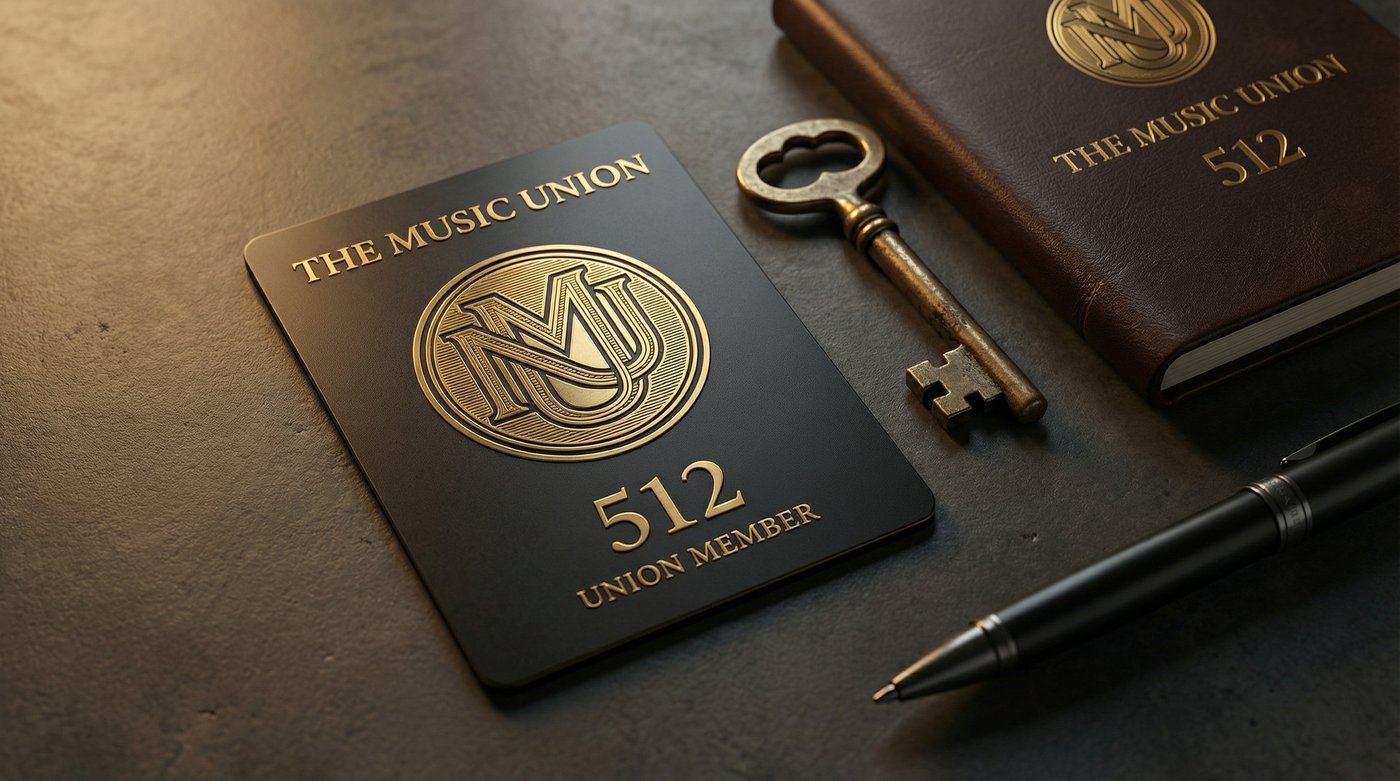
Union Card — 512 · Austin
The Physical Card
| Tier | Material | Finish |
|---|---|---|
| Rehearsal Member | Brushed steel | Matte silver with etched chapter number |
| Studio Member | Matte black steel | Etched red type and chapter number |
| Union Member | Gloss black steel | Deep-etched gold chapter numbers |
| Patron (Fan) | Same metal | Different colorway — signals a different kind of belonging |
| Founding Partner | Heavy-gauge brass | Gold foil, different finish, founding year etched on back |
Every card is the same size. Every card has the same hole. At The Union Stage on a Saturday night, a Rehearsal Member and a Founding Partner are both wearing their cards on a lanyard. They look different. They mean different things. But they are both members of the same Union — and that is the point.
Domain & Digital Identity
| Channel | Format | Purpose |
|---|---|---|
| Master brand URL | musicunion.co | National identity, press, expansion, membership portal |
| Chapter URLs | 512.musicunion.co, 615.musicunion.co | Local calendar, room booking, community content |
| Social handles | @musicunion | Instagram, TikTok, X, YouTube — master brand |
| Chapter social | @musicunion512, @musicunion615 | Local content, national brand consistency |
| [email protected] | Professional, chapter-specific, immediately recognizable |
The master brand (musicunion.co) carries the national identity — press coverage, expansion announcements, membership portal, and brand story. Each chapter's subdomain carries local booking, events, and community content. A touring musician finds their home chapter immediately. A national press outlet covers the brand as a whole. Both audiences are served without confusion or dilution.
Expansion Roadmap
Why Austin Is Chapter 1
- Cultural fit. Austin is the self-declared Live Music Capital of the World. It is the ideal proof-of-concept market for a music campus brand.
- Area code identity. 512 is one of the most beloved area codes in the country — worn on hats, tattooed, built into civic identity decades before we arrive.
- Real estate timing. The East Austin market is at an inflection point. The 4405 Springdale property is available at a valuation that allows conservative underwriting.
- Content campus fit. Austin's creative community — musicians, photographers, videographers, influencers, brand producers — is exactly the demographic the Every Surface Is a Set model was designed for.
- Texas anchor. A successful 512 chapter creates natural demand for a 214 chapter in Dallas — two chapters in the same state sharing supply chain, vendor relationships, and operational infrastructure.
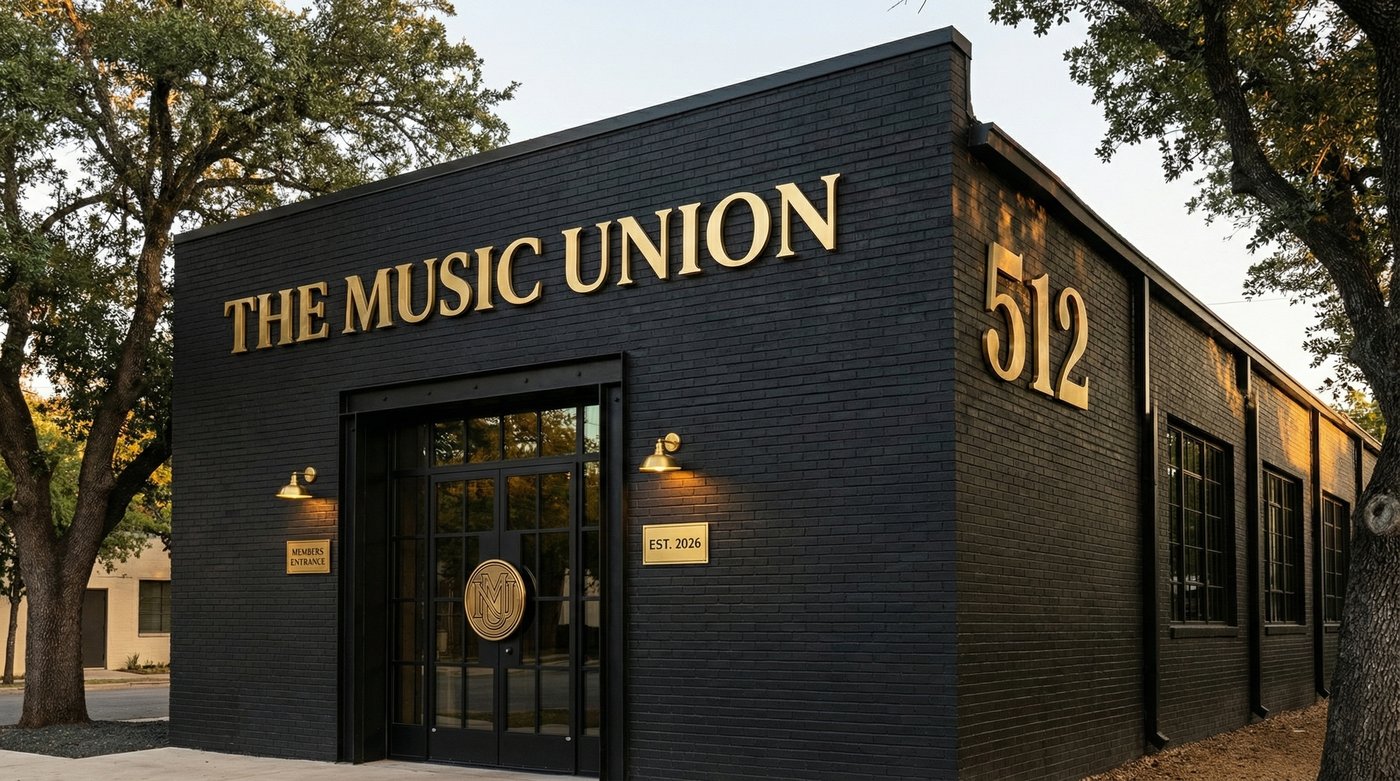
Austin — Chapter Exterior
Natural Chapter Sequence
After proving the model at 512, the natural Chapter 2 candidates are Nashville (615) and Los Angeles (213) — the two largest music industry hubs in the country with the deepest concentration of working musicians and industry professionals. Chicago (312) and New York (212) represent the Midwest anchor and East Coast flagship. New Orleans (504) is a unique long-term opportunity: the most music-culturally rich city in America per capita, significantly underserved by professional creative infrastructure.
Ownership Structures
Chapters can be structured as company-owned locations, joint ventures with local real estate partners, or licensed franchises under a consistent brand standards agreement. The founding chapter model — where a local real estate partner handles acquisition and buildout while The Music Union contributes brand, playbook, systems, and membership network — is the preferred structure for rapid early expansion.
The Competitive Moat
- Network Effect. A Union Card that works in Austin is worth more once Nashville opens. The membership product increases in value with every new chapter — at no additional cost to the member.
- Marketing Flywheel. Every chapter opening is national news for the brand. A press story about 615 in Nashville also markets 512 in Austin. The chapters market each other.
- Proprietary Playbook. The themed rooms, the Every Surface Is a Set design philosophy, the Union Card system, the music industry coworking model — this is the most valuable asset after the brand itself.
- Touring Musician Loyalty. The musician who is a 512 member and finds The Music Union in every city they play has no reason to book anywhere else. This loyalty compounds with every new chapter.
- Community as Asset. The Hall of Fame wall fills, the Sticker Bomb Wall layers, the mural program expands. The campus becomes more irreplaceable the longer it operates.
- First-Mover Naming. Once The Music Union owns "The Union" in a city's music vocabulary, no competitor can use that language.
"You don't open new locations. You charter new chapters." This distinction — in language, in structure, in culture — is what separates The Music Union from every music campus that has come before it.
The Power of National Scale
Multi-City Tour Booking — Outside the Monopoly
The live music industry's booking and ticketing infrastructure is dominated by Live Nation and Ticketmaster — a vertical monopoly that controls venues, ticketing, and artist management simultaneously. The Music Union's chapter stages create an independent touring circuit that operates entirely outside this system. A band in Austin can book a run through Dallas (214), Nashville (615), Atlanta (404), Chicago (312), and New York (212) using chapter venues they are already members of.
Direct-to-fan ticketing. The Union builds its own ticketing infrastructure across all chapters. Fan email addresses, purchase history, and engagement data stay with the Union and the artist — not with Ticketmaster. Over time this becomes one of the most valuable independent music databases in the country.
Member Benefits That Only National Scale Can Provide
- Group Health Insurance. A national membership base of working musicians across 20 cities creates a purchasing pool large enough to negotiate real group health insurance rates — potentially the single most valuable benefit in the history of music infrastructure.
- Retirement Planning. A national Music Union membership at scale could provide access to a group 401(k) or SEP-IRA structure with favorable contribution limits — infrastructure that working musicians simply do not currently have.
- Gear and Instrument Insurance. Group rates for instrument, equipment, and touring gear coverage through a national insurance partner.
National Partner Network
A single music campus can negotiate a discount with a local guitar store. A national network with tens of thousands of active members negotiates with Fender, Gibson, Shure, Sweetwater, Apple, and Red Bull. The economics of partnership are completely different at scale.
Data Intelligence Across Markets
Across 20 chapters, The Music Union accumulates proprietary intelligence about the working music economy that no individual venue, booking agency, or streaming platform currently possesses in aggregate — booking trend data, artist development pipelines, and fan audience data that becomes one of the most valuable databases in independent music.
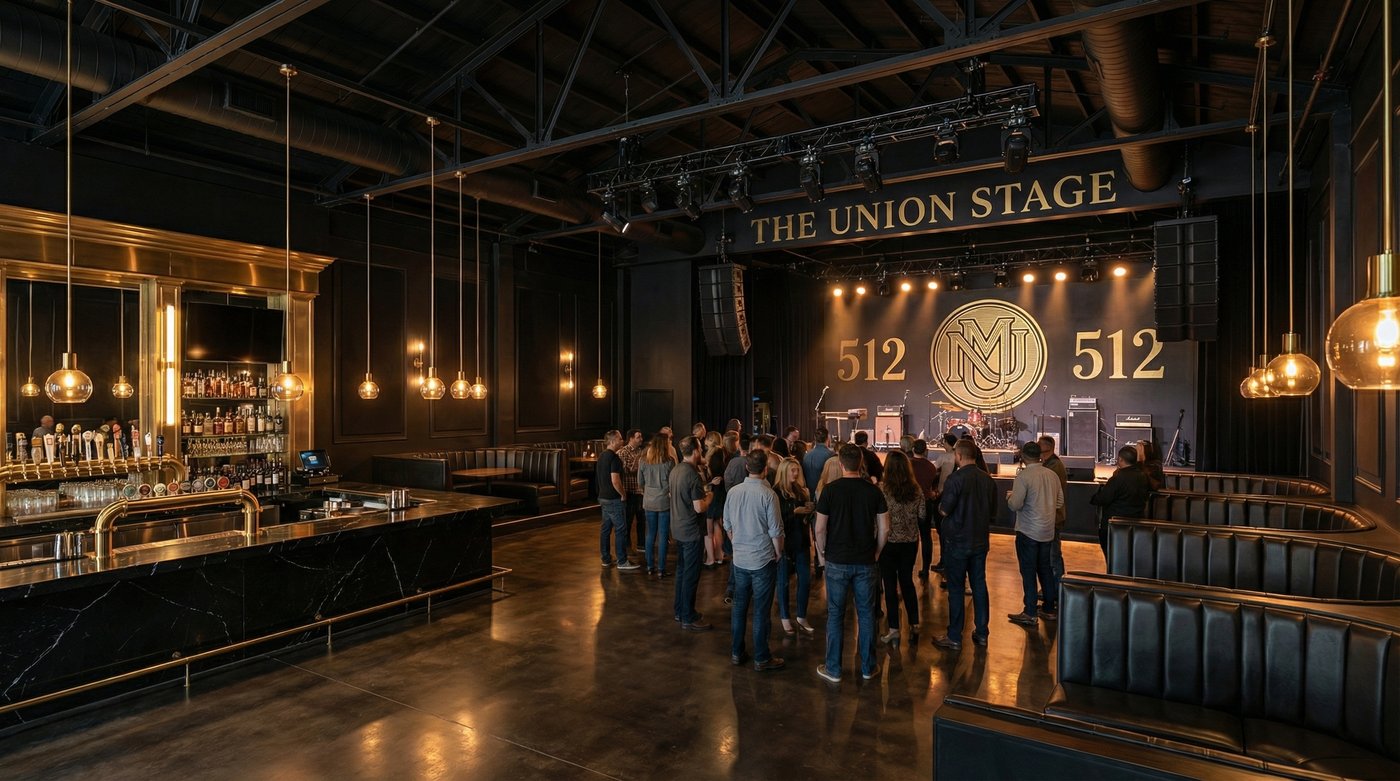
Music's Missing Institution
Doctors have the AMA. Lawyers have the Bar. Teachers have their unions. Truck drivers have the Teamsters. Working musicians have never had this. The Music Union, at national scale, is positioned to become the institution music has always lacked — not a lobbying group or an advocacy organization, but a practical, physical, everyday infrastructure that makes the working life of a musician more sustainable, more connected, and more powerful.
Membership Economics — Built for Members, Not for Shareholders
The Patronage Dividend Model
The core economic mechanic borrowed from cooperative business models is the patronage dividend: members earn back a portion of their annual spend at year-end, proportional to how much they used the campus. The more a musician rehearses, records, books shows, and engages with the Union, the larger their annual return.
The patronage dividend is the financial mechanism that makes "built for its members" literally true. It is not marketing language. It is how the money works.
Threshold-Based Governance Rights
| Tier | Requirements | Economic Rights | Governance Rights |
|---|---|---|---|
| Tier 1 — Financial Member | Active Union Card | Patronage dividend, partner discounts, insurance pool access | None — financial benefits only |
| Tier 2 — Community Member | 24+ consecutive months, $2,500+ annual spend | Enhanced dividend, priority booking, advisory input | Advisory (non-binding): programming, room additions, booking priorities |
| Tier 3 — Union Elder | 5+ years or $10K+ cumulative spend, or board nomination | Maximum dividend rate, full partner access, permanent locker | Binding vote on constitutional questions only: company sale, chapter closure, fundamental changes to member economics |
| Founders & Investors | Original capital and founding equity | Preferred economic returns, equity participation | Full operational governance at all times |
The Comparison That Matters
REI has 22 million active members and generates over $3 billion in annual revenue. Its co-op structure — patronage dividends, member ownership, a brand that cannot be sold without a member vote — is not just its legal form. It is its primary competitive advantage. The Music Union's membership economics model creates the same dynamic in music. Musicians choose The Union over any other rehearsal space, studio, or venue not just because of the rooms or the rates, but because of what The Music Union is: a place that is genuinely, financially, structurally built for them.
That is a moat. It is not easily copied. And it gets stronger with every member who earns their dividend, every chapter that opens, and every year the community grows.
Download the original document for full formatting and offline review.
Download Brand Strategy (PDF)